Old Woman Mountains Preserve (Mamápukaiv)
At a meeting point of three American deserts—the Mojave, Great Basin, and Colorado—Mamápukaiv is a landscape sacred to the Nuwuvi (Southern Paiute) and other California desert tribes. Now managed by the Native American Land Conservancy (with the support of the Twenty-Nine Palms Band of Mission Indians) as the 2,560-acre Old Woman Mountains Preserve, this area southwest of Needles is unique both for its natural and cultural history.
With pine, juniper, and wild grapevines, as well as wildlife including bighorn sheep and deer, it’s anything but a barren desert wasteland. There are ancient trails and such cultural sites as the 800-year-old petroglyphs at Painted Rock. The location’s cultural prominence is evident by its inclusion in the Salt Song Trail (Asi Huviav), a 142-cycle traditional song that describes the journey of two sisters between sacred spots scattered across Nuwuvi lands.
In a Mojave Project article about the Salt Song, artist and writer Kim Stringfellow quotes Kaibab Paiute elder Vivienne Jake, who said, “Salt Songs are a cultural and spiritual bond between the Nuwuvi people and the land, and represent a renewal and healing spiritual journey.”
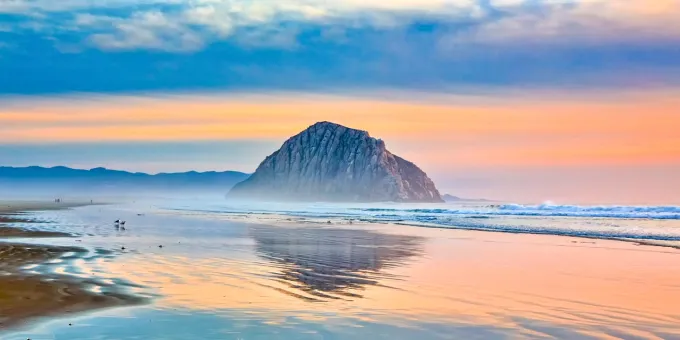
Morro Rock (Northern Chumash: Lisamu’; Salinan: Le’Samo)
Considered a high spiritual place for the Northern Chumash and Salinan peoples, 576-foot Morro Rock rises from the ocean at the entrance to Morro Bay. Home to nesting peregrine falcons (a Salinan legend featuring a falcon is set here) and the last in a chain of nine volcanic formations that begins near San Luis Obispo, Morro Rock, despite its sacred role, has endured more than its share of abuse.
In the late 1800s and into the 1900s, as much as 40 percent of the majestic rock was dynamited, hacked, and quarried to build the breakwater at nearby Port San Luis and for other projects. But Morro Rock is becoming whole again.
During a repair project at the Port San Luis breakwater, the U.S. Army Corps of Engineers determined that it would need larger pieces of stone to meet modern design standards. That meant much of the stone originally taken from Morro Rock couldn’t be reused. With that determination, the Chumash began working with the Corps and other government agencies to reunite the old breakwater material with Morro Rock itself.
In August 2022, 10,000 tons of boulders were barged to an underwater spot about 1,500 feet offshore from Morro Rock to create an artificial seamount and reef habitat for marine life. As Violet Sage Walker, chair of the Northern Chumash Tribal Council, said, “The reunification of Lisamu’ represents a healing of our people and our culture—a healing that is long overdue.”
While the public can observe the Salinan conduct ritual climbs of Morro Rock at the summer and winter solstice (the Northern Chumash oppose the practice), access to the formation itself is strictly prohibited. But you can walk near the base, and there are spectacular views of Morro Rock from points in town and Morro Strand State Beach just to the north.
Mount Diablo (Tuyshtak)
At 3,849 feet, Mount Diablo near Walnut Creek is a modest mountain by California standards. But because of its isolated position, surrounded by lower hills in the Coast Range and close to the western edge of the Central Valley, this peak that commands Mount Diablo State Park has views that extend 200 miles. And its summit is visible from spots throughout Northern California.
Despite a demonic sounding name bestowed by the Spanish, Mount Diablo had a very different symbolism for the many Native American tribes in the area that revered it. Tuyshtak, the Ohlonename for the peak, means “dawn of time.” According to the park website, the Julpun believed the mountain was the birthplace of the world, while the Northern Miwok “saw it as supernatural being that brought light to a dark world.”
According to tribal elders, Mount Diablo’s summit was used both for Pomo and Wintun religious ceremonies, as well as by individuals who came to the mountain to pray. These days you can drive directly to the top of the peak, although it’s far more satisfying to follow the 7-mile round trip Summit Trail, or a combination of different hiking routes to reach the summit.
Tolay Lake
One of Sonoma County’s largest freshwater lakes, Tolay Lake is a spiritual center for the Coast Miwok and Southern Pomo tribes, whose ancestors were part of the Alaguali Nation. Located about eight miles from Petaluma, the lake, which fills during the rainy season and is now part of 3,400-acre Tolay Lake Regional Park, has historically been a significant ceremonial gathering spot and healing place. When the shallow lake was drained in the 1870s, thousands of charmstones—small objects used for healing, fertility, and other purposes—were found along the bottom. Some of the charmstones were more than 4,000 years old.
On the park website, Greg Sarris, chairman of the Federated Indians of Graton Rancheria, explained the lake’s cultural significance. “The lake and surrounding area was highly sacred and was considered one of three areas in all of Northern California where Indian doctors from different tribes convened for sacred ceremonies and the exchange of ritual objects and songs for the purpose of healing.” The park has an 11-mile trail network for hiking and mountain biking with spectacular views of San Pablo Bay and all the way to San Francisco. There’s also excellent wildlife viewing, especially for birds of prey. And in recent years, the Tolay Fall Festival has featured Alaguali cultural activities, while the Federated Indians of Graton Rancheria have also hosted events at the parks.
Lassen Peak (Kohm Yah-Mah-Yee)
Long before the arrival of Europeans, the Achumawi, Atsugewi, Mountain Maidu, and Yahi/Yana peoples lived in the northeast California area now encompassed by Lassen Volcanic National Park. The archaeological record reveals evidence of human activity here at least as far back as 7,500 years ago. During summer, the four tribes gathered foods at higher elevations before returning to their villages at lower elevations with the arrival of winter. The descendants of these original inhabitants still live nearby and consider the entire park a sacred place, particularly 10,457-foot Lassen Peak, which holds a special spiritual significance.
To learn more about the native cultures of the park, stop into the Kohm Yah-mah-nee Visitor Center, located one mile from the park’s Southwest Entrance. In the Mountain Maidu language, the name Kohn Yah-mah-nee means “Snow Mountain,” and this was the first national parkvisitor center to receive a tribal name.
McArthur-Burney Falls
Anyone who has ever watched the delicate veils of water cascade down a 129-foot-tall moss-cloaked cliff face, then create rainbows over the cerulean pool at the base of McArthur-Burney Falls, would agree that this is a magical place. This transcendentally beautiful spot is the centerpiece of McArthur-Burney Falls Memorial State Park near the small town of Burney and about 64 miles northeast of Redding.
The Ilmawi, the first people to see the waterfall, considered it sacred, as do their modern-day descendants in the Pit River Tribe. According to a state parks document, “The falls were a source of good luck and power if one led a spiritually clean life,” and are still a site for pilgrimages and coming-of-age ceremonies.
Mount Shasta (Waka-nunee-Tuki-Wuki and Uhataahkoo)
Rising to 14,162 feet with a triangular, snowcapped summit visible from a vast area of Northern California, Mount Shasta plays a central role in the culture and religious traditions of the region’s indigenous peoples. The area’s tribes, including members of the Karuk, Pit River, Shasta, and Wintu, still conduct traditional rituals at sacred places along the slopes and within the forests of this vast volcanic peak—the second tallest in the Cascade Range. According to the Sacred Sites International Foundation, this mountain in the Shasta-Trinity National Forest is part of the creation stories of several tribes, while the Shasta Nation regards it as the birthplace of the Earth.
Because of their cultural significance, areas above the tree line have been designated as the Mount Shasta Cosmological District and, along with the mountain’s Panther Meadows, are considered eligible for inclusion on the National Historic Register of Historic Places.
The public is not invited to the ceremonies that take place at Mount Shasta. But you can explore on an extensive trail network, and there’s a walk-in campground (Mount Shasta’s highest) at Panther Meadows.