A Seaside Paradise owned by Filipino-American Retirees(David Balleza Katague & Macrine Nieva Jambalos)Boac,Marinduque, Philippines
WELCOME TO CHATEAU DU MER BEACH RESORT
If this is your first time in my site, welcome! Chateau Du Mer is a beach house and a Conference Hall. The beach house could now accommodate 10 guests, six in the main floor and four in the first floor( air conditioned room). In addition, you can now reserve your vacation dates ahead and pay the rental fees via PayPal. I hope to see you soon in Marinduque- Home of the Morions and Heart of the Philippines. The photo above was taken during our first Garden Wedding ceremony at The Chateau Du Mer Gardens. I have also posted my favorite Filipino and American dishes and recipes in this site. Some of the photos and videos on this site, I do not own, but I have no intention on the infringement of your copyrights!
Marinduque Mainland from Tres Reyes Islands
View of Marinduque Mainland from Tres Reyes Islands-Click on photo to link to Marinduque Awaits You
Last December 2, 2021 date if written as "12022021" is not only a palindrome (the same front to back) but it’s also an
ambigram which means it’s the same upside down as well!
The
above date was published in my FB page just recently for Nerds Alert.
However, it aroused my interest on playing with Numbers,Palindromes and
ambigram. A palindrome is a word, sentence, number, phrase, or other sequence of characters which reads the same backward as forward, such as madam, radar or racecar.
There are also numeric palindromes, including date/time stamps using short digits 11/11/11, 11:11 and long digits 02/02/2020.
Sentence-length palindromes ignore capitalization, punctuation, and
word boundaries.Here's a short video on palindromic numbers.
What do you mean by playing with numbers?
Playing with numbers involves
activities like arranging
the numbers, understanding BODMAS rule*, finding out whether a given
number is a factor of another number or a multiple of another number,
understanding the properties of factors and multiples. Also, it involves
learning how to use an index or exponent for a number, simplification
of brackets, multiples and factors, divisibility rules from 2 to 11,
the concept of co-prime numbers and prime factorization, finding HCF and LCM, etc.,
*The BODMAS rule states we should calculate the Brackets first (2 + 4 = 6), then the Orders (52
= 25), then any Division or Multiplication (3 x 6 (the answer to the
brackets) = 18), and finally any Addition or Subtraction (18 + 25 = 43).
Example of Playing with Numbers:
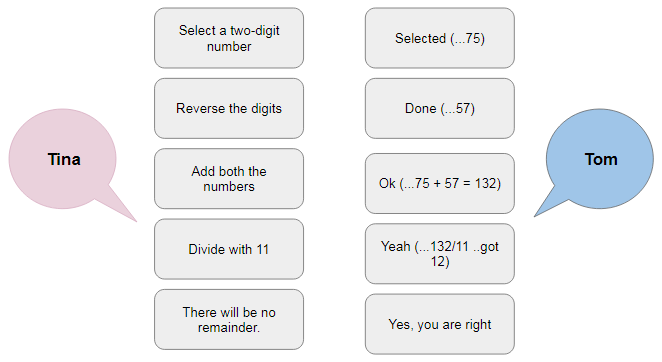
There are several tricks with numbers to test divisibility by other numbers.
Reversing the digits of a two-digit number
Similarly, we can try reversing the digits for dividing by 9.
Selecting a two-digit number: 25
Reversing the digits: 52
Subtract: 52-25 = 27
Divide by 9: 27/9 = 3
Remainder is 0.
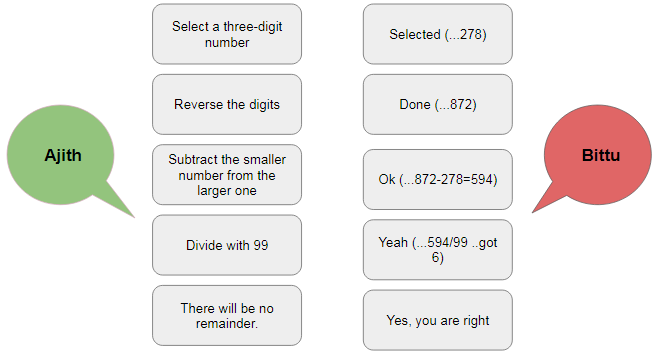
Reversing the digits of a three-digit number
Forming three-digit number from the given three digits
For a given three-digit number, rearrange the digits such that all
the three numbers are distinct and add them all. Then dividing it by 37,
the remainder is always 0.
Yesterday's
80th anniversary of the bombing of Pearl Harbor reminded of my memories
of the world War II as a child growing up in Panay Island, Philippines.
The war has affected million of lives all over the world including my
own. I sometimes wonder what my life would have been if Pearl Harbor was
not bombed. I would have not been able to experience my childhood years
in the small town where my mother was born. I would have been raised in
a modern small city with all the conveniences and not knowing how to
survive in the jungles of Panay Island without running water and
electricity.
Again
this year to celebrate this 80th anniversary of the start of WW II, I
am reposting the following article for your reading pleasure. If you
have read this before, my apologies, but remember There are no winners
in war, all are losers.
"Childhood Memories of the Japanese-American War in the Philippines"
The Bataan Death March
"War is a terrible thing to happen. Few among us have heard the stories
of civilians in the war zones. I saw and lived the anxieties and horrors
of the Japanese-American war through the eyes of a child. This article
(Part 1 of the trilogy) received the ViewsHound Gold Prize of $50 in 2011. ViewsHound is now a defunct writing site formerly based in UK.
Life in the time of war is a difficult experience for a child. All
school and play activities are interrupted. Survival amidst the chaos
becomes a paramount goal in life. Our family had to uproot ourselves
from the comfort of home and move several times to the hard life in the
countryside. We had to avoid the conflict and the bombing in the city.
We chose a life of peace and quiet away from the invading Japanese
troops. Due to the language barrier, the Japanese instilled order and
dominance of the conquered using fear, by hurting or killing innocent
civilians, resulting in the rise of the resistance movement. For every
day that passes, there was the dream of peace, but during the lengthy
war period, one had to expect the worst before anything good happened.
Before the war started, we lived a comfortable life in our home in the
city of Jaro, Iloilo located in the central Philippine island of Panay.
My father had a dental practice and we had our farm landholdings around
the province. It was 13 days before my 7th birthday when the Japanese
bombed Pearl Harbor in Hawaii in the morning of December 7, 1941.
On that evening, Japanese planes had taken off to attack several targets
in the Philippines, which was then an American colony. It was the start
of the Japanese invasion of the Philippines, and the reign of fear was
about to begin.
I was in 2nd grade at the Jaro Elementary School when Japan started
bombing the bigger cities of the country. When we heard the terrifying
news, my parents became concerned for our safety and decided to get out
of the city, a possible bombing target.
They chose to move to our farm in the small town of Barotac Viejo,
Iloilo, my mother’s ancestral town 60 kilometers north of Jaro. It was a
time of panic, chaos and fear over what was to happen in the city. We
were about to leave our cherished home and anxiously head to the
unfamiliar and unknown.
Within a couple of days all the essential items we could bring were
already packed. All the furniture and the huge and heavy items were left
behind. My mother had all her china and silverware buried in the
backyard for safekeeping.
We found out later that our house was bombed and totally destroyed. All
the furniture were either destroyed or stolen. All the china and
silverware was dug up and stolen. Despite the losses, we were grateful
that we made a wise decision and survived unharmed.
For a short period we settled in a small farm house of our tenant in a
remote district of town. As the war progressed, we were informed that
the Japanese forces had penetrated most of the big cities in the country
and were starting to occupy smaller towns. My father was a captain and
dental officer of the newly organized Philippine guerrillas, an
underground resistance movement to fight the Japanese. As a precaution,
he decided to move our family a second time, to the jungle in the
interior of Panay Island.
We had to walk for three days through the woods of the jungle, cross
over numerous creeks and climb over mountains with the help and guidance
of our farmer tenants. Our trek ended and we settled in a hidden valley
lined by a creek with clean running water. Our tenants built us a hut
for shelter made of bamboo and nipa palm, an outdoor kitchen and a
dining area.
They used a bamboo cart pulled by a water Buffalo to bring us supplies
of rice, salt, sugar and other spices regularly. In the valley we
cleared the land to plant vegetables, corn and sweet potatoes. We also
raised chickens and ducks for eggs, pigs for protein and goats for milk.
One of the scariest events while living in the jungle was when our pig
livestock were preyed upon by a python snake measuring about 30 feet
long. It was pitch black at night when we heard our two pigs squealing
out loud in fear. My father instructed our helper to inspect the pig pen
using a kerosene lamp. He saw the snake strangling one of the pigs. He
struck and killed the python using his machete and a piece of wood,
sadly, our small pig also died. That whole week we had protein in our
meals. It was proof that the jungles of Panay are inhabited by dangerous
pythons.
We had no pet with us. I chose the chickens and the goats to become my
pets. I raised one of the chickens; it slept with me, got attached to me
and kept trailing me wherever I go. My mother tolerated my unusual pets
because I had no peers my age aside from my younger brother.
To continue with our education, my father home schooled us together with
two of my older cousins. For four hours each day we were taught
arithmetic, spelling and history. We were lucky to have brought with us a
few books on Philippine and US history. Whenever our tenants brought us
food supplies, they would update us on news about the status of the
Japanese occupation.
Late in the war when the Japanese brutality and atrocities appeared to
have stopped, we moved again from the jungle to a seaside village. We
stayed at the house of another tenant. My father warned us not to talk
to any stranger, and if asked, to avoid giving our real last name of
Katague and instead provide an alias which was Katigbak. There were
unverified rumors that the Japanese had a list of names of all the
guerrillas, which might have included my father. Some traitor Filipinos
worked as spies for the Japanese by pinpointing the guerrillas in
exchange for favors.
One day, we saw a platoon of uniformed Japanese soldiers armed with guns
and bayonets passing by our village. My brother and I watched them
march while hiding in the bushes. I knew their brutal reputation towards
the natives, and I was afraid of us being seen and getting in trouble. I
was relieved that nothing happened and they continued with their march
to the next village.
A terrible incident happened to about 30 of my maternal relatives while
we were living in the jungle. They were similarly hiding and living in
the jungle on a mountain ridge next to us. They were killed by the
Japanese soldiers who discovered and penetrated their location with the
help of the spies. A handicapped relative in a wheelchair was spared.
During the massacre, she fell on the creek and must have been left for
dead. She lived to tell the tragic story. This is only one example of
many atrocities that was committed by the Japanese to the Filipino
civilians.
When General MacArthur landed in Leyte on October 1944, it was the
happiest day for the Filipinos, the Americans were back to save us from
the Japanese tyranny. The Japanese troops started to retreat and
surrender. The chance for peace in the Philippines was welcomed with
excitement. The schools were planning to reopen. There was no more need
to live in hiding and in fear, and to lie about one’s name. We were able
to live free from the oppressors.
From the seaside village we moved to another district much closer to
town where we built a bigger house. At the back of the property was a
hill, and on a clear day, from the top of the hill you could see the
nearby island of Negros. We used it as an observation hill where we
could watch the Japanese and American planes flying and then fighting
each other. My brother and I witnessed two planes attacking each other,
with one plane being blown to pieces and burning as it fell from the sky
to the sea between Panay and Negros islands. It was a thrilling
dogfight show to watch, although we never found out the victor.
When school reopened, we were required to take a test to determine which
grade level we would qualify for. I passed the test for a 4th grade
level. I was merely in grade 2 when war broke out. In short, I completed
six grades of elementary in only four years of schooling. In class, I
was two years younger than most of my classmates. I was thankful for the
result of my father’s patience in home schooling us while living in the
jungle. At last we were able to go back to our school, new home, and
live the life of what was left of my childhood years in peace.
Always remember that there are no winner of wars. Everybody are losers!!"
I
wrote this article a decade ago today. I believe the contents of this
article is still valid today except the costs and success rate.
Development of New Drugs in the United States Schematic
Image from medscape.com
As a retired FDA involved in the development of new drugs in the
Division of Anti-Infective Drug Products, Office of New Drug Chemistry, I
had often been asked by several of my blog readers to write a summary
and an overview of new drug development in the US. I had been postponing
it, because I thought the subject is confidential, but when I started
browsing in the WEB today, I found several articles on the subject. I
even found a Chemistry manufacturing supplement that I had approved
several years ago. The letter of approval and the chemist review was
printed in the Internet. However, the specifics of the supplement was
erased in the approval letter as well as in the chemist review. The
patent of the drug discussed had expired, so it is open to generic
companies, otherwise the chemist review and letter of approval will
never be made public. I am getting out of the subject, but let me start
on the subject right now.
New Chemical Entity (NCE) development
Broadly the process can be divided into pre-clinical and clinical work.
Pre-clinical.
New Chemical Entities (NCEs)(also known as New Molecular Entities
(NMEs)) are compounds which emerge from the process of drug discovery.
These will have promising activity against a particular biological
target thought to be important in disease; however, little will be known
about the safety, toxicity, pharmacokinetics and metabolism of this NCE
in humans. It is the function of drug development to assess all of
these parameters prior to human clinical trials. A further major
objective of drug development is to make a recommendation of the dose
and schedule to be used the first time an NCE is used in a human
clinical trial ("first-in-man" (FIM) or First Human Dose (FHD)).
In addition, drug development is required to establish the
physicochemical properties of the NCE: its chemical makeup, stability,
solubility. The process by which the chemical is made will be optimized
so that from being made at the bench on a milligram scale by a synthetic
chemist, it can be manufactured on the kilogram and then on the ton
scale. It will be further examined for its suitability to be made into
capsules, tablets, aeresol, intramuscular injectable, subcuteneous
injectable, or intravenous formulations. Together these processes are
known in preclinical development as Chemistry, Manufacturing and Control (CMC).
Note: The CMC portion of was my primary function as the Team Chemistry Leader during my employment with FDA
Many aspects of drug development are focused on satisfying the
regulatory requirements of drug licensing authorities. These generally
constitute a number of tests designed to determine the major toxicities
of a novel compound prior to first use in man. It is a legal requirement
that an assessment of major organ toxicity be performed (effects on the
heart and lungs, brain, kidney, liver and digestive system), as well as
effects on other parts of the body that might be affected by the drug
(e.g. the skin if the new drug is to be delivered through the skin).
While, increasingly, these tests can be made using in vitro methods
(e.g. with isolated cells), many tests can only be made by using
experimental animals, since it is only in an intact organism that the
complex interplay of metabolism and drug exposure on toxicity can be
examined.
The information gathered from this pre-clinical testing, as well as
information on CMC, and is submitted to regulatory authorities (in the
US, to the FDA), as an Investigational New Drug application or IND. If the IND is approved, development moves to the clinical phase.
Clinical phase.
Clinical trials involves three steps: Phase I trials, usually in
healthy patients, determine safety and dosing Phase II trials are used
to get an initial reading of efficacy and further explore safety in
small numbers of sick patients Phase III trials a large, pivotal trials
to determine safety and efficacy in sufficiently large numbers of
patients
The process of drug development does not stop once an NCE begins
human clinical trials. In addition to the tests required to move a novel
drug into the clinic for the first time it is also important to ensure
that long-term or chronic toxicities are determined, as well as effects
on systems not previously monitored (fertility, reproduction, immune
system, etc.). The compound will also be tested for its capability to
cause cancer (carcinogenicity testing).
If a compound emerges from these tests with an acceptable toxicity
and safety profile, and it can further be demonstrated to have the
desired effect in clinical trials, then it can be submitted for
marketing approval in the various countries where it will be sold. In
the US, this process is called a New Drug Application or
NDA. Most NCEs, however, fail during drug development, either because
they have some unacceptable toxicity, or because they simply do not work
in clinical trials.
As this drug discovery process becomes more expensive it is becoming
important to look at new ways to bring forward NCEs. One approach to
improve efficiency is to recognize that there are many steps requiring
different levels of experimentation. The early phase of drug discovery
actually has components of real innovation, components of
experimentation and components that involve set routines. This model of
Innovation, Experimentation, and Commoditization ensures that new ways
to do work are adopted continually. This model also allows the
discipline to use appropriate internal and external resources for the
right work.
Costs
Studies published by diMasi et al in 2003 report an average pre-tax
cost of approximately $800 million to bring a new drug (i.e. a drug with
a new chemical entity) to market. A study published in 2006 estimates
that costs vary from around $500 million to $2 billion depending on the
therapy or the developing firm. A study published in 2010 in the journal
Health Economics, including an author from the US Federal Trade
Commission, was critical of the methods used by diMasi et al but came up
with a higher estimate of ~$1.2B. Critic Marcia Angell, M.D., a former
editor of the New England Journal of Medicine, has called that number
grossly inflated, and estimates that the total is closer to $100
million. A 2011 study also critical of the diMasi methods, puts average
costs at $55 million.
Success rate
Candidates for a new drug to treat a disease might theoretically
include from 5,000 to 10,000 chemical compounds. On average about 250 of
these will show sufficient promise for further evaluation using
laboratory tests, mice and other test animals. Typically, about ten of
these will qualify for tests on humans. A study conducted by the Tufts
Center for the Study of Drug Development covering the 1980s and 1990s
found that only 21.5 percent of drugs that start phase I trials are
eventually approved for marketing. Now you know why the drugs you
purchased in the pharmacy is very expensive ( except the generic drugs).
Most Americans will not be able to afford new drugs if they do not have
insurance.
The mission of FDA is to enforce laws enacted by the U.S. Congress
and regulations established by the Agency to protect the consumer's
health, safety, and pocketbook. The Federal Food, Drug, and Cosmetic
Act20 is the basic food and drug law of the U.S. With numerous
amendments it is the most extensive law of its kind in the world. The
law is intended to assure consumers that foods are pure and wholesome,
safe to eat, and produced under sanitary conditions; that drugs and
devices are safe and effective for their intended uses; that cosmetics
are safe and made from appropriate ingredients; and that all labeling
and packaging is truthful, informative, and not deceptive.Code of Federal Regulations (CFR)
Code Of Federal Regulations (CFR)21. The final regulations published
in the Federal Register22 (daily published record of proposed rules,
final rules, meeting notices, etc.) are collected in the CFR. The CFR is
divided into 50 titles that represent broad areas subject to Federal
regulations. The FDA's portion of the CFR interprets the The Federal
Food, Drug, and Cosmetic Act23 and related statutes. Section 21 of the
CFR24 contains most regulations pertaining to food and drugs.
Note: I hope you found the above posting informative. My next
posting on this subject will be on the Chemistry, Manufacturing and
Control(CMC) Requirements for IND's and NDA's. If you find this posting
either boring or interesting, let me know via comments. Thank You.
Comment:
Anonymous
said...You have a very informative article, I hope the FDA does not condone
your site for writing about their business. Would you know how much the
FDA charges drug companies for testing each of their new drugs from
start to finish? This must cost them a bundle because, FDA employs a
plethora of highly educated doctors, scientists, mathematicians and
business people. Jeffrey Ray
A
very interesting interview about the development of new drugs by Dan
Skovronsky, Director of Research and Development, Eli Lily.
Meanwhile enjoy this photo from my collection-My Pineapple in my front Patio almost ready to be harvested.
My Twenty Five Favorite Quotes on Gratitude and Thankfulness
Last
week was my 61 years of experiencing the Thanksgiving Holiday here in
the US. It reminded me of my favorite quotes on Thankfulness and
Gratitude I am posting today.
Here are 25 quotes about gratitude and thankfulness that
will not only remind you that what you have is pretty awesome, but will
also, I hope, spur you to express that gratitude to the people who deserve it most.
"Feeling gratitude and not expressing it is like wrapping a present and not giving it." William Arthur Ward
"I would maintain that thanks are the highest form of thought; and that gratitude is happiness doubled by wonder." G.K. Chesterton
"'Enough' is a feast. Buddhist proverb
"If you count all your assets, you always show a profit." Robert Quillen
"Enjoy the little things, for one day you may look back and realize they were the big things." Robert Brault
"As we express our gratitude, we must never forget that the highest appreciation is not to utter words but to live by them." John F. Kennedy
"Reflect upon your present blessings, of which every man has plenty; not on your past misfortunes, of which all men have some." Charles Dickens
"Acknowledging the good that you already have in your life is the foundation for all abundance." Eckhart Tolle
"If a fellow isn't thankful for what he's got, he isn't likely to be thankful for what he's going to get." Frank A. Clark
"If you want to turn your life around, try thankfulness. It will change your life mightily." Gerald Good
"Gratitude turns what we have into enough, and more. It turns denial
into acceptance, chaos into order, confusion into clarity...it makes
sense of our past, brings peace for today, and creates a vision for
tomorrow." Melody Beattie
"The world has enough beautiful mountains and meadows, spectacular
skies and serene lakes. It has enough lush forests, flowered fields, and
sandy beaches. It has plenty of stars and the promise of a new sunrise
and sunset every day. What the world needs more of is people to
appreciate and enjoy it." Michael Josephson
"Gratitude is a currency that we can mint for ourselves, and spend without fear of bankruptcy." Fred De Witt Van Amburgh
"The way to develop the best that is in a person is by appreciation and encouragement." Charles Schwab
"He is a wise man who does not grieve for the things which he has not, but rejoices for those which he has." Epictetus
"At times, our own light goes out and is rekindled by a spark from
another person. Each of us has cause to think with deep gratitude of
those who have lighted the flame within us." Albert Schweitzer
"The deepest craving of human nature is the need to be appreciated." William James
"Be thankful for what you have; you'll end up having more. If you
concentrate on what you don't have, you will never, ever have enough." Oprah Winfrey
"Let us rise up and be thankful, for if we didn't learn a lot today,
at least we learned a little, and if we didn't learn a little, at least
we didn't get sick, and if we got sick, at least we didn't die; so, let
us all be thankful." Buddha
"Silent gratitude isn't very much to anyone." Gertrude Stein
"Thankfulness is the beginning of gratitude. Gratitude is the
completion of thankfulness. Thankfulness may consist merely of words.
Gratitude is shown in acts." Henri Frederic Amiel
"You cannot do a kindness too soon because you never know how soon it will be too late." Ralph Waldo Emerson
"When I started counting my blessings, my whole life turned around." Willie Nelson
"It is impossible to feel grateful and depressed in the same moment." Naomi Williams
"One can never pay in gratitude; one can only pay 'in kind' somewhere else in life." Anne Morrow Lindbergh
I
have been enjoying my favorite movies, TV shows, and Documentaries for
the last several months with streaming services besides my Comcast Cable
Subscription. I have Netflix, Hulu and Amazon Prime Video Subscriptions. With my cable subscription I have access to HBO Max, Disney+and Peacock. My favorites are of course Netflix and Hulu. Netflix is currently the most popular streaming service in the world, with around 207 million subscribers.
Bundling subscriptions can save you money.
Today, TV viewers in the US have more places to watch their favorite movie and shows. Choosing the right
streaming service for your home entertainment setup will depend on a
number of factors, including your budget, which exclusive programs you
like the most, how many screens you want to watch on, and other factors.
Here's
a summary to help you decide what to sign up for, rounding up the best
streaming services of 2021. These picks are primarily
focus on on-demand platforms like
Netflix and
Hulu, but also includes separate sections for live TV and specialty streaming channels.
I
was watching the Macy Parade last Thursday on NBC. After the parade I
accidentally did not closed the TV. The next show was the National Dog
Show. For some reason I decided to watch it. It turned out to be an
informative show and it reminded me of an article I wrote just recently.
The Katague family are dog and cat lovers. I remember when the kids
were growing up we have pet dogs and cats. Some of the breeds we have
were a Samoyd( Meling), a Chow Chow ( Miko), a German Shepherd( Devil)
and a few other mixed breeds. For details on the Dog Show this year
read:
Experiencing the Empty Nest Syndrome? Adopt a Pet Dog!!
I
was messaging a friend in FB recently about her feelings of emptiness,
since her last child went to college last month. It reminded me of my
article about the empty nest syndrome(ENS) that I wrote a few years ago.
In this article I wrote about Macrine (RIP) feelings, when our oldest
son left home for college to UC Berkeley. I am posting here excerpts of
that article. In this article there were suggestions in how to cope up
with ENS. Today I think one of the ways to cope with ENS is to adopt a
pet- a dog specifically. Would you agree?
I was exchanging messages with a relative in FB recently. In our
conversation, she mentioned that all her children have left the house
and she misses them. I informed her she is suffering from empty nest syndrome
and it is normal or another stage in one's life as we age. Here's her
exact words. I am not mentioning her name for the sake of anonymity.
"I was in tears reading your blog (Thank You Lord,I have Thoughtful
Relatives). It reminds me of our situation....just me and my husband in a
4,000sq. ft. house and I have to do the cleaning. My health is not
good. I miss my children, how happy and busy was our household before
and now they are busy in their professions and family. My eldest who has
his medical practice in San Antonio, Texas. He calls us every Sunday,
the second one calls when he has a chance. His having two kids is hard
and my daughter calls when she remembers. They are all in medical field
so working night shifts sometimes is hard. I will have them read your
blog. Thanks Nong David".
Here's my response:
I appreciate your feedback, I think your feeling is very normal at this
stage of your life. You are suffering from-empty nest syndrome. Keep
busy and just count your blessings. Are you still working? Keep in
touch! Give my regards to the family!
Empty nest syndrome is a feeling of grief and loneliness parents or
guardians may feel when their children leave home for the first time,
such as to live on their own or to attend a college or university. It is
not a clinical condition.
All parents are susceptible to empty nest syndrome, although some
factors can create a predisposition to it. Such factors include an
unstable or unsatisfactory marriage, a sense of self based primarily on
identity as a parent, or difficulty accepting change in general.
Full-time parents (stay-at-home mothers or fathers) may be especially
vulnerable to empty nest syndrome. Adults who are also dealing with
other stressful life events such as menopause, the death of a spouse, or
retirement are also more likely to experience the syndrome.
Symptoms of empty nest syndrome can include depression, a sense of loss
of purpose, feelings of rejection, or worry, stress, and anxiety over
the child's welfare. Parents who experience empty nest syndrome often
question whether or not they have prepared adequately for their child to
live independently.
Parents going through empty nest syndrome can ease their stress by pursuing their own hobbies and interests
in their increased spare time. Discussing their grief with each other,
friends, families, or professionals may help them. Experts have advised
that overwhelmed parents keep a journal, or go back to work if they were
full-time parents.
Our personal experience with empty nest syndrome started when our oldest
son, went to college. My wife did cry and I told her he will be back at
the end of the week to do his laundry. My wife finally accepted the
fact that her oldest child is growing up and let him go. This feeling of
loneliness was repeated four times, since we have four children. Their
first day away from home always gave us a feeling of sadness. The first
one was the hardest and the last one was the easiest.
Finally if you are in the stage of your life when you children has to go
to college or live by themselves, do not feel sad, It is part of the
stage of life. Keep busy and try to communicate to them as often as you
can. Otherwise get a Pet Dog or Cat!
Our First Thanksgiving Day in the US, Danville, Illinois, 1960
Tomorrow will be my 61 years of celebrating thanksgiving day here in the US.
This year thanksgiving celebration will be in Palo Alto, CA
at the residence of Charo Jambalos Levin. Charo is Macrine's youngest
sister. The Jambalos and Katague clan are all invited for a Pot Luck
lunch. The last time I heard there are more than 20 coming. David E and I
decided not to attend, because I do not want to torture myself with the
expected 3-4 hours bumper to bumper traffic from Sacramento to Palo
Alto. David and I will have just honey-baked ham, potato salad, sweet
potatoes and cranberry sauce and pumpkin pie with ice cream for
dessert.
Thanksgiving Day reminds me of the First Thanksgiving
Day in the US that I have experienced. I am reposting my memories of
that day as follows:
Our First Thanksgiving Day in United States, 1960
It
was on November, 1960 when Macrine and I and our oldest son,Dodie(who was
only 2 years old then) experienced our first Thanksgiving Celebration in
the United States. That year, I was a graduate student at the
University of Illinois at the Medical Center in Chicago. The Chicago
Hospitality Center along with YMCA and CFM invites all Foreign students
in the area to spend a Thanksgiving weekend to the homes of volunteers
in small towns of Illinois away from the crowded city of Chicago. Some
of my foreign student friends were reluctant and did not accept the
invitation, but I had an adventurous spirit so with great anticipation,
Macrine and I along with Dodie went with 12 other foreign students and
their families to Central Illinois. Our host for that weekend was Mrs.
Johnston, a widow from Danville, Illinois. She lives alone and her
beautiful bungalow house right in downtown Danville. We left Chicago in
the morning, had thanksgiving dinner ( turkey and all its trimmings)in
late afternoon. This was followed by a program in the evening at a local
community center, where all the Hosts met and socialized with other
invited students from Korea, Iran, Mexico, Japan, Chile, South Africa,
Egypt and the Philippines. Macrine, Dodie and I represented the
Philippines. The next day we had a grand tour of the area, the farms
and then to Springfield, the capital of Illinois. The tour of the area
and Springfield was the highlight of our 2 days break from our hectic
schedules as a graduate students.
So, did I like the roasted
turkey? Nope, that was first time I had turkey. In the Philippines we do
not celebrate Thanksgiving and I had never tasted turkey before. I did
not like the pumpkin pie either. What I enjoyed was the oyster
stuffing,ice cream and the cranberries sauce.
So why do I write
this post? Well, to thank the Lord for all the good things and the past
49 years (61 years update this year) of Thanksgiving Days, He has given me and my family so far
here in US. In addition our visit to the “real” Americans ( not the Ugly
ones) that Thanksgiving day in 1960 prompted me to write an article of
my impressions of the US at that time and has remained in my memory
until today:
Our Impression of America
"
During our first year in Chicago, we never received an invitation to
participate in the hospitality program. Our name was probably buried in
the list of foreign students or perhaps our foreign student adviser was
sleeping in her job. During these first year of adjustments to the
American way of life, we formed a very wrong impression of Americans.
Asides from our daily contacts with fellow students in the school rooms
or dormitories, our only other social contacts were people in the
streets, subways, buses, department stores, supermarkets and other
public places. These were all artificial contacts, giving us an
impression that Americans are unfriendly, artificial, insincere,
apathetic,intolerant and above all ignorant.The latter adjective was
quite true, since the ordinary or typical American does not have the
vaguest idea where the Philippines, Japan or even Puerto Rico is located
in the map.
" However, in our second year, we began receiving
invitation to spend a weekend in suburban homes as well as dinner
invitations in city homes. At first, we were reluctant to accept the
invitation, however with our adventurous spirit, we said yes. From
then on, "we have the whole world in our hands". We are thankful to CFM,
the YWCA and the Hospitality Center of Chicago for making our stay
filled with pleasant memories.
"On the other hand what
impressions could we have brought back to the Philippines, if our stay
was limited to one or two years ( true for exchange visitors). How many
visitors and exchange scholars brought home with them the wrong
impressions and attitude towards the American people in general? I knew
there were a few foreign students in the dormitories who were
disillusioned about the United States. One of them was a former dorm
mate from Chile. He received an invitation, but never did conquer his
apprehension of accepting one.
" At present as couple leader of
the first interfaith group in our diocese, we will do our very best to
reciprocate, promote, and encourage hospitality programs to foreign
students and scholars in our area. We believe that opening our homes and
our hearts on weekends and holidays, is one of the best ways of
promoting world peace and understanding. Let us then make it possible
for foreign students and scholars get the true picture of America and
its people. Let us give them the opportunity to share with us our way of
life. Let us get busy as a group or perhaps join other groups in order
that we can show to the future leaders of the world, how sincere,
friendly and aware we are of other human beings in other parts of the
world. This is one of the many ways we could be more Christlike, we
believe".
This letter was published by CFM in their monthly magazine, ACT, for all their members worldwide.
I also would like to dedicate this poem to all my readers in this blog. Thanksgiving Every Day-By Karl Fuchs
The table is brimming with good things to eat; We're surrounded by family and friends; what a treat. The feelings that fill us today can’t be beat; It’s Thanksgiving Day, and it all feels complete. But other days, sometimes things don’t seem so fine; Those days are not polished and don’t seem to shine. It's then in our minds, we forget all the good, And think of the things we would get, if we could. On days when our thinking causes us dread, If we could remember, it’s all in our head, And not let our minds take our gratitude away, Then we'd make every day like Thanksgiving Day.
HAPPY THANKSGIVING TO ALL! What are you thankful for this year?
Are you fully vaccinated? If not, I hope Covid-19 does not catch you for good!
Meanwhile enjoy these photos from my garden this week
My Tangerine fruits this year ( harvested one the other day).
Cacti and my rose last bloom for this year
Azaleas starting to bloom on my side yard pathway!
The
other day, I posted a list of popular fruits in the Philippines. This
posting is about the Marang Fruit that I have never tasted.
The
Marang is a fruit that I have never tasted in the Philippines, because
it seasonal and rarely available in Metro Manila. However, I have heard
of the health benefits of this fruit.
Marang (Artocarpus odoratissimus)
is a species of flowering plant in the
Moraceae family. It is a commonly called marang, madang, timadang,
terap, tarap, green pedalai, or johey oak. It belongs to the breadfruit
family and grows abundantly in Mindanao, Southern Philippines.
Here's an article from the Philippine News on the Health Benefits of the Marang Fruit
Marang is an exotic and delicious fruit that contains numerous
vitamins and minerals, which has beneficial effects on the body’s
health.
Marang is also known as “Artocarpus Odoratissimus,” a tree came from
the mulberry and fig family of Moraceae. This fruit can be usually found
in tropical climate countries such as the Philippines, but it is also
cultivated all around the world.
It is also quite related to the fruits such as cempedak, jackfruit,
and breadfruit trees. This fruit is very popular worldwide, because of
its, sweet, unique, juicy, and delicious taste. Most Filipinos love to
eat Marang, because of its flavor and health benefits.
It has been also traditionally used by ancient people in treating and
preventing numerous types of diseases, because of its medicinal
properties. It contains a high nutritional value, which has beneficial
effects on the body.
It contains vitamins A, B, C, beta-carotene, dietary fiber, retinol,
thiamin, riboflavin, pantothenic acid, and niacin. It contains minerals
such as zinc, iron, phosphorus, protein, potassium, calcium, manganese,
copper, and magnesium.
It also contains antibacterial, antiviral, anticancer, and
anti-inflammatory properties. It also contains a lot of antioxidants
that can help the body to fight free radicals, which can cause harm to
the body.
It can be also used as a natural alternative for the expensive
treatments and medications in the hospitals and medical clinic. Aside
from being an effective remedy, it is also more affordable compared to
the high-cost medications.
Here are some of the amazing health benefits of eating marang fruit:
Prevents cancer
Controls Diabetes
Reduce Cholesterol Levels
Relieves Constipation
Prevents Heart Diseases
Prevents Anemia
Improves Digestion
Enhances Metabolism
Improves Vision
Prevents Stroke
Relieves Inflammation
Personal Note:
I was born and lived in the Philippines until I was 23 years old but
have never tasted this fruit. I am now in my mid-80 and realized that I
am still learning new things. I have tasted the durian ( candy but not
the fresh one), guayabano( sour sop), atis ( custard apple), Jackfruit
and star apple. The taste of marang have been described as a combination
of the above fruits. I am longing to taste this marang fruit.
Meanwhile, see this photo of my potted ampalaya starting to fruit
Ampalaya
( bitter melon) should be planted in the Ground. But my backyard is
small, so I planted it in a pot. It is growing, but not as luxuriant if
it were planted in the Ground.
I am also proud to show my pineapple harvest in my front porch this year.




 -


