A Seaside Paradise owned by Filipino-American Retirees(David Balleza Katague & Macrine Nieva Jambalos)Boac,Marinduque, Philippines
WELCOME TO CHATEAU DU MER BEACH RESORT
If this is your first time in my site, welcome! Chateau Du Mer is a beach house and a Conference Hall. The beach house could now accommodate 10 guests, six in the main floor and four in the first floor( air conditioned room). In addition, you can now reserve your vacation dates ahead and pay the rental fees via PayPal. I hope to see you soon in Marinduque- Home of the Morions and Heart of the Philippines. The photo above was taken during our first Garden Wedding ceremony at The Chateau Du Mer Gardens. I have also posted my favorite Filipino and American dishes and recipes in this site. Some of the photos and videos on this site, I do not own, but I have no intention on the infringement of your copyrights!
Tuesday, February 14, 2017
The Basic Metabolic Panel Blood Test
For the last couple of decades prior to our quarterly medical check up, Macrine and I are required by our family physician to take the basic metabolic panel blood test. I was curious why and what possible diseases it can detect. Here's a summary of what I found in the web for your information.
The tests that make up the basic metabolic panel are blood (serum) tests for:
1. BUN (blood urea nitrogen)
This test measures the amount of nitrogen in the blood.
2. CO2 (carbon dioxide or bicarbonate)
This test references lung and kidney function.
3. Creatinine
Creatinine levels can tell your doctor how your kidneys are functioning.
4. Glucose
A glucose test checks your blood sugar levels—abnormally high or low glucose levels could indicate a range of issues.
5. Sodium
This test determines if the concentration of sodium is within normal limits. It is part of your electrolyte panel.
6. Potassium
Your potassium levels are tested as part of your electrolyte panel.
7. Calcium
Testing for the calcium levels in your blood can help determine if there is a kidney, bone, or nervous system problem.
8. Chloride
Chloride levels are checked as part of your electrolyte panel.
9. Albumin
A few laboratories also include tests for albumin, which tests blood protein levels to test for kidney and liver disease.
The basic metabolic panel can give your doctor a good idea if you have any serious problems with: blood filtration, acid/base balance of your blood, blood sugar levels, and electrolyte levels. This can help uncover kidney problems, lung problems, certain heart problems, and problems with your pancreas or insulin metabolism. More detailed tests and additional will be ordered if any of these basic indicators are abnormal.
One advantage of a panel of tests is that many tests can be done with just one blood sample that is divided up in the laboratory.
For Colon Cancer: There is the SimpliPro Colon test but it is not intended for use as a screening test or for patients without symptoms associated with colorectal cancer or advanced adenoma. You will need to have a colonoscopy to confirm if you have colon cancer.
Reference:https://medlineplus.gov/ency/article/003462.htm
Happy Valentine's Day to All You, my beloved Readers!
Sunday, February 12, 2017
Why Saffron is the Most Expensive Spice
Saffron threads for Spice (More expensive than gold)
A Camel Ride in Tangier, Morocco during our visit in 2000.(http://davidbkatague.blogspot.com/search?q=tangier%2C+morocco)
Macrine and I had our first experience with buying Saffron when we visited Morocco, North Africa (in 2000) during our one day tour to Tangier from Gibraltar, Spain . However, the price per ounce in Tangier was still cheaper if you compared the spice sold here in the US.
Saffron, the most expensive spice, estimated price is about $1,500 per pound and up so it is usually sold only by the gram or ounce-just a small cluster of slender red threads in a tiny glass bottle. At the Spice House in Chicago, owners Tom and Patty Erd sell a gram of superior grade saffron for $6.79, and an even finer version, known as coupé grade, for $8.29.
The threads are the stigmas of tiny crocuses, grown primarily in Spain, Iran, Greece and India. Since each flower only has three stigmas, many blossoms are needed to produce even a small amount of spice. It takes an acre of land and hundreds of thousands of flowers to produce one pound of saffron threads.
Saffron, which Patty Erd calls "a classic," has been a key ingredient in cuisines since ancient times, and it is commonly used to make risotto, bouillabaisse and paella. Fortunately, a little saffron goes a long way and most recipes call for just a pinch.
"There are 200 to 300 threads per gram, and you only need a few threads at a time," Erd says. "You use it so sparingly that in the long run it's not much more expensive than any other spice."
Saffron as a Appetite Suppressant
Vanilla Saffron Imports president Juan San Mames advises buyers that they invest on a good quality product. His San Francisco direct-import business currently offers saffron for $1,162.24 per pound, or $72.95 per ounce, and carefully vets its saffron for compliance with ISO standards. (Yes, the ISO has saffron specifications.) Cheap saffron producers often leave in the tasteless yellow stamens, adding weight and diluting the red stigmas that give the spice its famous taste.
If you still can not afford Saffron for spice, a cheaper and good substitute is turmeric powder/extract. We called turmeric dilaw ( means yellow) in Marinduque, Philippines and is the most popular spice ( yellow coloring) for a few Filipino dishes, such as chicken adobo sa Gata. Both turmeric and saffron had anti-inflammatory activity and are used as herbal drugs/dietary supplements for a variety of ailments.
References:
1. money.cnn.com/galleries/2008/fsb/0807/gallery.most_expensive_foods.../4.html
2. http://www.dailymail.co.uk/news/article-2823029/How-ounce-saffron-expensive-gold-Cultivation-exotic-spice-returns-Essex-time-200-years.html
A Camel Ride in Tangier, Morocco during our visit in 2000.(http://davidbkatague.blogspot.com/search?q=tangier%2C+morocco)
Macrine and I had our first experience with buying Saffron when we visited Morocco, North Africa (in 2000) during our one day tour to Tangier from Gibraltar, Spain . However, the price per ounce in Tangier was still cheaper if you compared the spice sold here in the US.
Saffron, the most expensive spice, estimated price is about $1,500 per pound and up so it is usually sold only by the gram or ounce-just a small cluster of slender red threads in a tiny glass bottle. At the Spice House in Chicago, owners Tom and Patty Erd sell a gram of superior grade saffron for $6.79, and an even finer version, known as coupé grade, for $8.29.
The threads are the stigmas of tiny crocuses, grown primarily in Spain, Iran, Greece and India. Since each flower only has three stigmas, many blossoms are needed to produce even a small amount of spice. It takes an acre of land and hundreds of thousands of flowers to produce one pound of saffron threads.
Saffron, which Patty Erd calls "a classic," has been a key ingredient in cuisines since ancient times, and it is commonly used to make risotto, bouillabaisse and paella. Fortunately, a little saffron goes a long way and most recipes call for just a pinch.
"There are 200 to 300 threads per gram, and you only need a few threads at a time," Erd says. "You use it so sparingly that in the long run it's not much more expensive than any other spice."
Saffron as a Appetite Suppressant
Vanilla Saffron Imports president Juan San Mames advises buyers that they invest on a good quality product. His San Francisco direct-import business currently offers saffron for $1,162.24 per pound, or $72.95 per ounce, and carefully vets its saffron for compliance with ISO standards. (Yes, the ISO has saffron specifications.) Cheap saffron producers often leave in the tasteless yellow stamens, adding weight and diluting the red stigmas that give the spice its famous taste.
If you still can not afford Saffron for spice, a cheaper and good substitute is turmeric powder/extract. We called turmeric dilaw ( means yellow) in Marinduque, Philippines and is the most popular spice ( yellow coloring) for a few Filipino dishes, such as chicken adobo sa Gata. Both turmeric and saffron had anti-inflammatory activity and are used as herbal drugs/dietary supplements for a variety of ailments.
References:
1. money.cnn.com/galleries/2008/fsb/0807/gallery.most_expensive_foods.../4.html
2. http://www.dailymail.co.uk/news/article-2823029/How-ounce-saffron-expensive-gold-Cultivation-exotic-spice-returns-Essex-time-200-years.html
Saturday, February 11, 2017
Turmeric and Arthritis Management
Two weeks ago, I posted in my blogs that I have been diagnosed with mild to moderate form of arthritis in my left knee. My sister-in-law and daughter as well as another FB friend recommended that I take turmeric since they found it to be useful in their arthritis. I was not sure what dosage form I should take, I did some research and here's what I found about turmeric and its health benefits.
(https://authoritynutrition.com/top-10-evidence-based-health-benefits-of-turmeric/)
Turmeric is the spice that gives curry its yellow color. It has been used in India for thousands of years as a spice and medicinal herb. Recently, science has started to back up what the Indians have known for a long time… it really does contain compounds with medicinal properties.
These compounds are called curcuminoids, the most important of which is curcumin. Curcumin is the main active ingredient in turmeric. It has powerful anti-inflammatory effects and is a very strong antioxidant.
However, the curcumin content of turmeric is not that high… it’s around 3%, by weight. Most of the studies on this herb are using turmeric extracts that contain mostly curcumin itself, with dosages usually exceeding 1 gram per day. It would be very difficult to reach these levels just using the turmeric spice in your foods. Therefore, if you want to experience the full effects, then you need to take an extract that contains significant amounts of curcumin.
Unfortunately, curcumin is poorly absorbed into the bloodstream. It helps to consume black pepper with it, which contains piperine… a natural substance that enhances the absorption of curcumin by 2000%
Because curcumin is known for its powerful anti-inflammatory and pain reducing characteristics, a study was conducted on 45 rheumatoid arthritis patients to compare the benefits of curcumin in turmeric to arthritis drugs (diclofenac sodium), that put people at risk of developing leaky gut and heart disease.
The study split these volunteers into three groups: curcumin treatment alone, diclofenac sodium alone, and a combination of the two. The results of the trial were eye-opening:
The curcumin group showed the highest percentage of improvement in overall [Disease Activity Score] scores and these scores were significantly better than the patients in the diclofenac sodium group. More importantly, curcumin treatment was found to be safe and did not relate with any adverse events. Our study provides the first evidence for the safety and superiority of curcumin treatment in patients with active RA, and highlights the need for future large-scale trials to validate these findings in patients with RA and other arthritic conditions.
Published by Phytotherapy Research in 2012, the results of this study has encouraged more human research to evaluate the amazing effects curcumin-rich plants like turmeric has on people suffering from various different types of arthritis.
A Bottle of turmeric Capsules, my daughter gave me as a gift provided I take the Capsules
One of the dosage form found effective is from 1000mg to 1200mg per day capsules. Virtually no side effects except constipation. If you are reading this and taking turmeric for your arthritis, I like to hear from you.
(https://authoritynutrition.com/top-10-evidence-based-health-benefits-of-turmeric/)
Turmeric is the spice that gives curry its yellow color. It has been used in India for thousands of years as a spice and medicinal herb. Recently, science has started to back up what the Indians have known for a long time… it really does contain compounds with medicinal properties.
These compounds are called curcuminoids, the most important of which is curcumin. Curcumin is the main active ingredient in turmeric. It has powerful anti-inflammatory effects and is a very strong antioxidant.
However, the curcumin content of turmeric is not that high… it’s around 3%, by weight. Most of the studies on this herb are using turmeric extracts that contain mostly curcumin itself, with dosages usually exceeding 1 gram per day. It would be very difficult to reach these levels just using the turmeric spice in your foods. Therefore, if you want to experience the full effects, then you need to take an extract that contains significant amounts of curcumin.
Unfortunately, curcumin is poorly absorbed into the bloodstream. It helps to consume black pepper with it, which contains piperine… a natural substance that enhances the absorption of curcumin by 2000%
Because curcumin is known for its powerful anti-inflammatory and pain reducing characteristics, a study was conducted on 45 rheumatoid arthritis patients to compare the benefits of curcumin in turmeric to arthritis drugs (diclofenac sodium), that put people at risk of developing leaky gut and heart disease.
The study split these volunteers into three groups: curcumin treatment alone, diclofenac sodium alone, and a combination of the two. The results of the trial were eye-opening:
The curcumin group showed the highest percentage of improvement in overall [Disease Activity Score] scores and these scores were significantly better than the patients in the diclofenac sodium group. More importantly, curcumin treatment was found to be safe and did not relate with any adverse events. Our study provides the first evidence for the safety and superiority of curcumin treatment in patients with active RA, and highlights the need for future large-scale trials to validate these findings in patients with RA and other arthritic conditions.
Published by Phytotherapy Research in 2012, the results of this study has encouraged more human research to evaluate the amazing effects curcumin-rich plants like turmeric has on people suffering from various different types of arthritis.
A Bottle of turmeric Capsules, my daughter gave me as a gift provided I take the Capsules
One of the dosage form found effective is from 1000mg to 1200mg per day capsules. Virtually no side effects except constipation. If you are reading this and taking turmeric for your arthritis, I like to hear from you.
Thursday, February 9, 2017
Diet, Exercise and My Arthritis
Three weeks ago, my left knee was in pain and my personal physician confirmed it after an X'ray as a start of a mild to moderate form of Arthritis. There is no cure to arthritis but your diet could affect and reduce the swelling besides taking anti-inflammatory drugs such as Naprosin and other analgesics. I did some research on what foods to take as well as to avoid. The site below described foods that helps in reducing swelling and may reduce pain to a more manageable level.
The best approach to food for people with arthritis is a well-balanced diet which, according to the U.S. Food and Drug Administration, should be centered on plant-based foods. Approximately two-thirds of your diet should come from fruits, vegetables and whole grains. The other third should include low-fat dairy products and lean sources of protein. Fish Products are also highly recommended.
Exercise is one of the best things you can do to help your knees by helping maintain range of motion and strengthening the muscles that support them. Research shows that even relatively minor increases in the strength of the quadriceps – the muscles that run along the front of the thigh – can help reduce the risk of knee osteoarthritis and its progression, and reduce pain. Exercise can be helpful for other forms of arthritis, too, because it strengthens the muscles that support the joint. Proper exercise also may reduce the risk of knee injury and, if you need knee surgery, it will make recovery easier.
Knee Anatomy-I think my quadriceps muscles are the one slightly inflamed.
For detail information on diets and arthritis read the site below:
http://www.arthritis.org/living-with-arthritis/arthritis-diet/foods-to-avoid-limit/food-ingredients-and-inflammation-11.php
Tuesday, February 7, 2017
Facing the Realities of Getting Older-Arthritis
Our latest Photo- Aging Gracefully?
The last couple of years, I remember I did not feel old at all although I was already on my late 70's. Four years ago prior to the PD diagnosis of my spouse for over 59 years( this May 8 will be our 60th year anniversary), I felt young, energetic and hopeful. I remember that four years ago, I was not only mentally, and physically fit, but also spiritually fit. The thought of getting old had not occurred in my mind at that time.
Today, I do not feel young and although I am mentally and spiritually fit, my physical fitness as of today in now in limbo and in question. You do need the three items namely physical, mental and spiritual fitness not to feel old.
It started about ten days ago. One morning I woke up with a lingering pain on my left knee. On a scale of 1 to 10, I felt it was about a 3 to 4. I can still tolerate it without taking any pain medications. As the days progressed I tried massage, heat therapy and mild exercise. Nothing works, I have to take aspirin.
The other day, I decided to see my family physician. He examined my left knee and thinks it must be a torn ligament in the knee or a start of arthritis, since the pain appears to be aggravated by cold temperature. He ordered an X'ray, prescribed (Naprosin ) an anti-inflammatory/analgesic drug and a knee support hose. The Naprosin and the Knee support seems to help alleviate the pain, but I am not completely pain free.
Today I got the results of the X'ray. No torn ligaments but the start of arthritis. So what is arthritis. Here's an excerpt from www.athritis.org
Arthritis is very common but is not well understood. Actually, “arthritis” is not a single disease; it is an informal way of referring to joint pain or joint disease. There are more than 100 different types of arthritis and related conditions. People of all ages, sexes and races can and do have arthritis, and it is the leading cause of disability in America. More than 50 million adults and 300,000 children have some type of arthritis. It is most common among women and occurs more frequently as people get older.
Common arthritis joint symptoms include swelling, pain, stiffness and decreased range of motion. Symptoms may come and go. They can be mild, moderate or severe. They may stay about the same for years, but may progress or get worse over time. Severe arthritis can result in chronic pain, inability to do daily activities and make it difficult to walk or climb stairs. Arthritis can cause permanent joint changes.
On a positive note: I passed my driver's license renewal for another five years after submitting the results of my vision test from my ophthamologist. I am however restricted to day driving and no extensive freeway driving. This is good enough for me as I only drive to the grocery and drug stores and once or twice a month to the Casino. Although I have no official restriction on Night Driving, I seldom drive at night and will do it only on emergency.
Related Blog: http://chateaudumer.blogspot.com/search?q=aging+gracefully
The last couple of years, I remember I did not feel old at all although I was already on my late 70's. Four years ago prior to the PD diagnosis of my spouse for over 59 years( this May 8 will be our 60th year anniversary), I felt young, energetic and hopeful. I remember that four years ago, I was not only mentally, and physically fit, but also spiritually fit. The thought of getting old had not occurred in my mind at that time.
Today, I do not feel young and although I am mentally and spiritually fit, my physical fitness as of today in now in limbo and in question. You do need the three items namely physical, mental and spiritual fitness not to feel old.
It started about ten days ago. One morning I woke up with a lingering pain on my left knee. On a scale of 1 to 10, I felt it was about a 3 to 4. I can still tolerate it without taking any pain medications. As the days progressed I tried massage, heat therapy and mild exercise. Nothing works, I have to take aspirin.
The other day, I decided to see my family physician. He examined my left knee and thinks it must be a torn ligament in the knee or a start of arthritis, since the pain appears to be aggravated by cold temperature. He ordered an X'ray, prescribed (Naprosin ) an anti-inflammatory/analgesic drug and a knee support hose. The Naprosin and the Knee support seems to help alleviate the pain, but I am not completely pain free.
Today I got the results of the X'ray. No torn ligaments but the start of arthritis. So what is arthritis. Here's an excerpt from www.athritis.org
Arthritis is very common but is not well understood. Actually, “arthritis” is not a single disease; it is an informal way of referring to joint pain or joint disease. There are more than 100 different types of arthritis and related conditions. People of all ages, sexes and races can and do have arthritis, and it is the leading cause of disability in America. More than 50 million adults and 300,000 children have some type of arthritis. It is most common among women and occurs more frequently as people get older.
Common arthritis joint symptoms include swelling, pain, stiffness and decreased range of motion. Symptoms may come and go. They can be mild, moderate or severe. They may stay about the same for years, but may progress or get worse over time. Severe arthritis can result in chronic pain, inability to do daily activities and make it difficult to walk or climb stairs. Arthritis can cause permanent joint changes.
On a positive note: I passed my driver's license renewal for another five years after submitting the results of my vision test from my ophthamologist. I am however restricted to day driving and no extensive freeway driving. This is good enough for me as I only drive to the grocery and drug stores and once or twice a month to the Casino. Although I have no official restriction on Night Driving, I seldom drive at night and will do it only on emergency.
Related Blog: http://chateaudumer.blogspot.com/search?q=aging+gracefully
Sunday, February 5, 2017
Under the Banyan Tree-Jessie Lichauco
Jessie Lichauco
I recommend this Vimeo video by Arturo Prins in case you have not seen it. For the synopsis read below.
https://vimeo.com/162550581
“Under the Banyan tree” is a documentary exploring the inner world, memories and experiences of a 105-year-old Philippine woman, Nana Jessie. The life of a woman who at 18 left her birthplace in Cuba, to travel across land and ocean all by herself, to meet her future husband, Marcial Lichauco, in Manila. This is the portrait of a life full of adventure and unusual situations, embracing from before World War II to the present day. A house packed with old books, antiques, exotic objects, stuffed wild animals, photo albums, cats, dogs and a huge two hundred year old banyan tree next to the Pasig River, will be the supporting actors at the background of her memories. Through them and a clownish historical guide named Carlos, we will discover the history of a country, the traces of the Spanish and North American colonization, as well as the violent Japanese invasion during World War II.
The film is a kaleidoscopic glance at Grandma Jessie´s recollections, a dance with ghosts arising from her past: the turbulent XXth century Philippine history. A poetic mapping of the home where she lived almost all her life, enduring war amongst other hazardous situations, always protected by the presence of the eternal banyan tree, a symbol of permanence and stability. A centennial woman, much like the Pasig waters, softly caressing the river bank close to the house, with its boats and humble people.
A historical review of Philippine XXth century through the photographic albums; a series of interviews to the offspring of Philippine prostitutes and soldiers from the North American military base, socially excluded individuals, deprived of any citizenship rights; talks with some of Jessie´s seven children; conversations with survivors from the concentration camps during the War; participation in local folk dances; enjoying beautiful landscapes; mingling with today’s inhabitants along the river. All of these will merge into a surprising, unpredictable film about a family, a country, a history.
This is not a regular documentary, but rather a joyful song about everything surrounding Jessie, her photo albums, her furniture, the stuffed antelopes and lions, the magical corners of a home haunted by memories. Silent pauses, thoughtful gazes towards the river, the people surrounding her, a visual poetry telling us of her life, her feelings, her dead husband, her children, her home, her country. A picture where peace and violence, wealth and poverty, curiosity and love, youth and old age, sadness and joy, all take turns to leave a mark on her soul. An unexpected look into a country and its people, a road with an unforeseen end, bright images connecting and wrapping us with memories, secrets, past emotions, through the eyes and voice of this wise, adorable woman.
Here's a short biography of Marcial Lichauco, husband of Jessie from Wikipedia:
Marcial Primitivo Lichauco born in November 27, 1902 in Manila, was the youngest son of Faustino Lichauco (February 16, 1870, Binondo, Manila - June 15, 1930), a member of Emilio Aguinaldo's Revolutionary Junta, and Luisa Fernández y Arcinas (June 21, 1873, Binondo, Manila - September 10, 1959).
Lichauco studied at the American-established Central School in Manila. After having graduated as the valedictorian of his class, he entered Harvard University. In 1923, he became the first Filipino to graduate from Harvard. He later studied at Harvard Law School and graduated in 1926.
Throughout the period, Lichauco traveled in the United States delivering speeches promoting the idea of Philippine independence. He collaborated with Moorfield Storey to publish "The Conquest of the Philippines by the United States" to draw attention to the Philippine-American war.
In the 1930s, Lichauco was secretary to the OsRox Mission, which traveled to the United States Congress to urge passage of a bill granting independence to the Philippines. This ultimately became the Hare-Hawes-Cutting Act.
Lichauco spent WW-II in occupied Manila. After the war, Lichauco published "Dear Mother Putnam" to document day-to-day life in Japanese-occupied Manila.
In 1963, President Diosdado Macapagal appointed Marcial Lichauco as Philippine Ambassador to the United Kingdom, Denmark, Norway and Sweden. Lichauco served in that post until 1966.
Related Information: https://en.wikipedia.org/wiki/Curiosity,_Adventure,_and_Love
Personal Note: I first heard of the Lichauco's through Veronica( Ronie) Feria Nieva, my wife's( Macrine's) second cousin. Ronie's grandmother was Maria Arevalo y Lichauco who was married to Gregorio Morente Nieva. Gregorio was the younger brother of Macrine's grandfather Juan Morente Nieva.
I recommend this Vimeo video by Arturo Prins in case you have not seen it. For the synopsis read below.
https://vimeo.com/162550581
“Under the Banyan tree” is a documentary exploring the inner world, memories and experiences of a 105-year-old Philippine woman, Nana Jessie. The life of a woman who at 18 left her birthplace in Cuba, to travel across land and ocean all by herself, to meet her future husband, Marcial Lichauco, in Manila. This is the portrait of a life full of adventure and unusual situations, embracing from before World War II to the present day. A house packed with old books, antiques, exotic objects, stuffed wild animals, photo albums, cats, dogs and a huge two hundred year old banyan tree next to the Pasig River, will be the supporting actors at the background of her memories. Through them and a clownish historical guide named Carlos, we will discover the history of a country, the traces of the Spanish and North American colonization, as well as the violent Japanese invasion during World War II.
The film is a kaleidoscopic glance at Grandma Jessie´s recollections, a dance with ghosts arising from her past: the turbulent XXth century Philippine history. A poetic mapping of the home where she lived almost all her life, enduring war amongst other hazardous situations, always protected by the presence of the eternal banyan tree, a symbol of permanence and stability. A centennial woman, much like the Pasig waters, softly caressing the river bank close to the house, with its boats and humble people.
A historical review of Philippine XXth century through the photographic albums; a series of interviews to the offspring of Philippine prostitutes and soldiers from the North American military base, socially excluded individuals, deprived of any citizenship rights; talks with some of Jessie´s seven children; conversations with survivors from the concentration camps during the War; participation in local folk dances; enjoying beautiful landscapes; mingling with today’s inhabitants along the river. All of these will merge into a surprising, unpredictable film about a family, a country, a history.
This is not a regular documentary, but rather a joyful song about everything surrounding Jessie, her photo albums, her furniture, the stuffed antelopes and lions, the magical corners of a home haunted by memories. Silent pauses, thoughtful gazes towards the river, the people surrounding her, a visual poetry telling us of her life, her feelings, her dead husband, her children, her home, her country. A picture where peace and violence, wealth and poverty, curiosity and love, youth and old age, sadness and joy, all take turns to leave a mark on her soul. An unexpected look into a country and its people, a road with an unforeseen end, bright images connecting and wrapping us with memories, secrets, past emotions, through the eyes and voice of this wise, adorable woman.
Here's a short biography of Marcial Lichauco, husband of Jessie from Wikipedia:
Marcial Primitivo Lichauco born in November 27, 1902 in Manila, was the youngest son of Faustino Lichauco (February 16, 1870, Binondo, Manila - June 15, 1930), a member of Emilio Aguinaldo's Revolutionary Junta, and Luisa Fernández y Arcinas (June 21, 1873, Binondo, Manila - September 10, 1959).
Lichauco studied at the American-established Central School in Manila. After having graduated as the valedictorian of his class, he entered Harvard University. In 1923, he became the first Filipino to graduate from Harvard. He later studied at Harvard Law School and graduated in 1926.
Throughout the period, Lichauco traveled in the United States delivering speeches promoting the idea of Philippine independence. He collaborated with Moorfield Storey to publish "The Conquest of the Philippines by the United States" to draw attention to the Philippine-American war.
In the 1930s, Lichauco was secretary to the OsRox Mission, which traveled to the United States Congress to urge passage of a bill granting independence to the Philippines. This ultimately became the Hare-Hawes-Cutting Act.
Lichauco spent WW-II in occupied Manila. After the war, Lichauco published "Dear Mother Putnam" to document day-to-day life in Japanese-occupied Manila.
In 1963, President Diosdado Macapagal appointed Marcial Lichauco as Philippine Ambassador to the United Kingdom, Denmark, Norway and Sweden. Lichauco served in that post until 1966.
Related Information: https://en.wikipedia.org/wiki/Curiosity,_Adventure,_and_Love
Personal Note: I first heard of the Lichauco's through Veronica( Ronie) Feria Nieva, my wife's( Macrine's) second cousin. Ronie's grandmother was Maria Arevalo y Lichauco who was married to Gregorio Morente Nieva. Gregorio was the younger brother of Macrine's grandfather Juan Morente Nieva.
Saturday, February 4, 2017
Have You Heard of Fr. Rene Javellana, S.J.?
During the last couple of months I have been writing about well-known members of the Javellana clan. My inspiration is that I am one of the thousands descendants of the Javellana clan via my father side of my family as documented by www.javellana.wordpress.com.
The name of Fr. Rene Javellana, S.J. was brought to my attention just recently via comments from a reader of my blog on my Javellana ancestry. I have heard of Fr Javellana and his works but have not meet him personally. Here's an excerpt from his biography from wikifilipinas.org
Rene Javellana, S.J., is a Jesuit priest, writer, liturgical artist and art historian. He is currently an associate (Thomas Gasson) professor at Ateneo de Manila University, where he is also director of the Fine Arts Program and creative director of Jesuit Communications. He holds a master’s degree in theology.
His research interests include colonial architecture and art in Asia; renaissance imprints and cultural dissemination; heritage conservation; popular religion and globalization; art, spirituality and religion; contemporary visual arts; art and communication theory; film, media and society; and online education. His inclination to the study of arts was for the reason that he considers art as a catalyst and mediator of cultural change. His interests lie in the intersection of cultures and institutions and the intersection of eras.
Here's an interesting TED video that he gave about the SELFIE:
Thursday, February 2, 2017
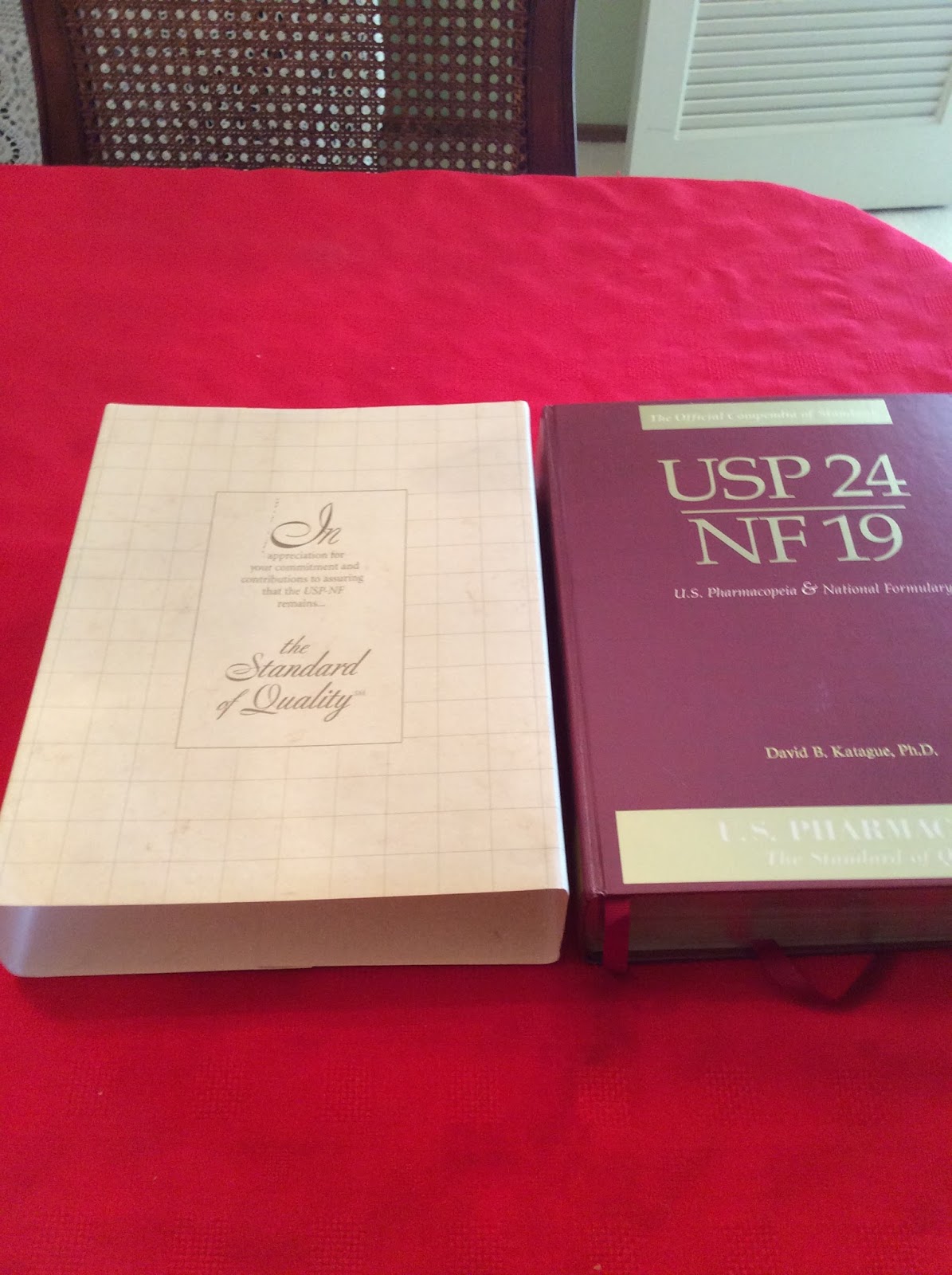
My Involvement with the United States Pharmacopeia( USP)
My Personal and Autographed Copy of the USP
The U.S. Pharmacopeial Convention (USP) is a scientific nonprofit organization that sets standards for the identity, strength, quality, and purity of medicines, food ingredients, and dietary supplements manufactured, distributed and consumed worldwide. USP’s drug standards are enforceable in the United States by the Food and Drug Administration, and these standards are used in more than 140 countries.
Since its founding in 1820, USP has helped secure the quality of the American drug supply. Building on that legacy, USP today works with scientists, practitioners, and regulators of many nations to develop and revise standards that help protect public health worldwide. Here's a short video about the USP Pharmacopeia.
My involvement with the United States Pharmacopeia(USP)started in 1995 and ended in 2005. In 1995, I was first elected to USP Council of Experts, Standards Division in the Antibiotics and Natural Products Committees. My first term of 5 years ended in 2000, but I was reelected to another five years term in 2000 ending in 2005. As an elected member of the Council of Experts, I was responsible for establishing standards of identity, safety, quality, purity of drug substances and drug products as well as in-vitro and diagnostic products, dietary supplements and related articles used in health care. Just in case you have not heard of USP...
The United States Pharmacopeia (USP) is the official pharmacopeia of the United States, published dually with the National Formulary as the USP-NF. The United States Pharmacopeial Convention (usually also called the USP) is the nonprofit organization that owns the trademark and copyright to the USP-NF and publishes it every year. Prescription and over–the–counter medicines and other health care products sold in the United States are required to follow the standards in the USP-NF. USP also sets standards for food ingredients and dietary supplements.
My election to the USP Council of Experts was a very selected process. In 1995, there were more than 700 scientist nation-wide from academia, government and private industry who volunteered to serve. USP selection committee narrowed it down to 256 final nominees. Of the 256 final nominees, only 128 were elected.
Election to the Council of Experts ( formerly known as the Committee of Revision) confirms that the person elected is both the national and international expert in the field of election. My field is in Antibiotics and natural products( botanical drugs).
As far as I know I was the first Filipino-American elected to USP since its inception in 1820. Approved drugs and new drugs to be marketed in US must comply with the USP requirements with regards to identity, safety, quality and purity. The USP/NF is used by pharmacists, chemists, physicians, nurses and other health care professionals as well as consumers. I am very proud of my ten years of involvement with USP during my active working years as an Analytical Chemist for four private companies and as a Chemistry Team Leader in FDA for 12 years.
Lastly, the University of the Philippines Chemistry Alumni Newsletter congratulated me on my election to the USP/CE with this note. " We join with your colleagues and your family in congratulating you for this singular honor, which bring prestige to the Philippines as well."
The U.S. Pharmacopeial Convention (USP) is a scientific nonprofit organization that sets standards for the identity, strength, quality, and purity of medicines, food ingredients, and dietary supplements manufactured, distributed and consumed worldwide. USP’s drug standards are enforceable in the United States by the Food and Drug Administration, and these standards are used in more than 140 countries.
Since its founding in 1820, USP has helped secure the quality of the American drug supply. Building on that legacy, USP today works with scientists, practitioners, and regulators of many nations to develop and revise standards that help protect public health worldwide. Here's a short video about the USP Pharmacopeia.
My involvement with the United States Pharmacopeia(USP)started in 1995 and ended in 2005. In 1995, I was first elected to USP Council of Experts, Standards Division in the Antibiotics and Natural Products Committees. My first term of 5 years ended in 2000, but I was reelected to another five years term in 2000 ending in 2005. As an elected member of the Council of Experts, I was responsible for establishing standards of identity, safety, quality, purity of drug substances and drug products as well as in-vitro and diagnostic products, dietary supplements and related articles used in health care. Just in case you have not heard of USP...
The United States Pharmacopeia (USP) is the official pharmacopeia of the United States, published dually with the National Formulary as the USP-NF. The United States Pharmacopeial Convention (usually also called the USP) is the nonprofit organization that owns the trademark and copyright to the USP-NF and publishes it every year. Prescription and over–the–counter medicines and other health care products sold in the United States are required to follow the standards in the USP-NF. USP also sets standards for food ingredients and dietary supplements.
My election to the USP Council of Experts was a very selected process. In 1995, there were more than 700 scientist nation-wide from academia, government and private industry who volunteered to serve. USP selection committee narrowed it down to 256 final nominees. Of the 256 final nominees, only 128 were elected.
Election to the Council of Experts ( formerly known as the Committee of Revision) confirms that the person elected is both the national and international expert in the field of election. My field is in Antibiotics and natural products( botanical drugs).
As far as I know I was the first Filipino-American elected to USP since its inception in 1820. Approved drugs and new drugs to be marketed in US must comply with the USP requirements with regards to identity, safety, quality and purity. The USP/NF is used by pharmacists, chemists, physicians, nurses and other health care professionals as well as consumers. I am very proud of my ten years of involvement with USP during my active working years as an Analytical Chemist for four private companies and as a Chemistry Team Leader in FDA for 12 years.
Lastly, the University of the Philippines Chemistry Alumni Newsletter congratulated me on my election to the USP/CE with this note. " We join with your colleagues and your family in congratulating you for this singular honor, which bring prestige to the Philippines as well."
Subscribe to:
Posts (Atom)