

During my elementary school years in Barotac Viejo, Iloilo, Philippines, my my mother taught me how to play Sungka. Our Sungka Board was very expensive, made of marble- a souvenir of our trip to Romblon Province. We also used shells for the beads. I remember there was a time when I memorized the sequence of moves that once I started, the opponents has zero Chance of Winning. This took years of playing, then memorizing the sequence of MOVES.
The following article I found in MY FaceBook today. I am sharing it with you. I believe if you have not travelled or resided in Southeast Asia, this game is not familiar to you. For details of the game read the following site:

"Sungka is a Philippine mancala game, which is now also played wherever Philippine migrants are living; e.g. in Macau, Taiwan, Germany, and the USA. Like the closely related Congkak it is traditionally a women's game.
Sungka was first described by the Jesuit priest Father José Sanchez in his dictionary of the Bisaya language (=Cebuano) in 1692 [manuscript] as Kunggit. Father José Sanchez who had arrived on the Philippines in 1643 wrote that at the game was played with seashells on a wooden, boat-like board. The Aklanon people still call the game Kunggit. José Sanchez (born Josef Zanzini [*1616-1692) in Trieste, Holy Roman Empire of the German Nation) is known for founding the town of Jagna on Bohol, which is today famous for its rich historical heritage.
There are Sungka tournaments in the Philippines, Taiwan, Australia, Austria, England and the USA. The biggest competition is held each year at the Kadayawan Sports Festival in Davao. In May 2006, the Philippine Empassy compound in Pretoria, South Africa, hosted a Sungka tournament during the ASEAN Games and Sports, which was held under the auspices of ASEAN Embassies based in South Africa. The six winners for the first Sungka game competition were participants from the following embassies: Vietnam, 1st; Malaysia, 2nd; Malaysia, 3rd; Indonesia, 4th; Philippines, 5th and Indonesia, 6th. In 2008, the Philippine Language and Cultural Association of Australia, Inc. (PLCAA) organized a Sungka competition at the Sydney Regatta Centre, Penrith. The Department of Computer Studies at the Imperial College of Science in London (England) held a computer tournament in 2004.
It is known that Sungka improves mathematical thinking and teaches patience and observation skills. The John W. Garvy Elementary School in Chicago (Illinois, USA) uses Sungka to help children with dyscalculia.
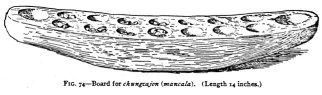
Traditional Sungka Board (Culin 1894)
Sungka is similar to many other Southern Asian mancala games such as Naranj (Maldives), Dakon (Java), Congkak(Malaysia, Singapore, Indonesia) and Chongka' (Marianas). The game differs from Kalah which is known in North America and Europe in being a multi-lap game. Another important difference is that the first move is executed simultaneously in Sungka which is meant to balance the game. Sungka is distinguished from Congkak by being played counterclockwise and also by some other minor rule differences.

Lastly, Did you know that the Philippines almost became a colony of Belgium in 1866? King Leopold II, infamous for his brutal exploitation of Congo, initially set his sights on the Philippines. He approached Spain, hoping to purchase the islands as Belgium’s first colony. However, the deal failed due to Spain’s reluctance and Leopold’s inability to secure financing from British banks.


No comments:
Post a Comment